If Your Team Is Running on Empty, Your Practice Is Paying the Price.
Healthcare doesn't have to mean burnout and compassion fatigue. Empower your staff to regulate stress, increase emotional resilience and elevate patient care.
I'm a Registered Nurse and Certified Burnout Recovery Coach. I bring science-backed, practical burnout workshops to healthcare teams, so your people can understand what's happening in their nervous systems and actually do something about it.
-
Reduce Turnover
Restore Team Morale
Increase Emotional Intelligence
CLICK BELOW TO WATCH FIRST!
You didn’t miss the class on staying sane in healthcare.
It was never taught.
Mental and emotional resilience in healthcare is the ultimate 'figure it out yourself' assignment.
You weren't taught or even saw it modeled for how to care for yourself while caring for others.
Healthcare professionals are carrying unprecedented levels of stress.
Burnout, turnover, and workplace tension are on the rise—and it’s costing teams more than just morale.
The Cost of Burnout Is Real
High turnover and staffing shortages
Increased sick days and missed shifts
Low morale and team conflict
Decreased patient satisfaction scores
Direct impact on reimbursement and reputation.
I specialize in guiding healthcare professionals to reduce stress, prevent burnout, and rediscover joy in their work using the Forward Facing® Method — a proven approach that has supported thousands of professionals since 1997.
With Forward-Facing® skills, your staff can regulate their stress response, reconnect with their values, refuel their passion and bring their best selves to work every day

You didn’t miss the class on staying sane in healthcare.
It was never taught.
Mental and emotional resilience in healthcare is the ultimate figure-it-out-yourself assignment. Your team was trained to care for others. Nobody taught them how to care for themselves while doing it, and nobody modeled it either. So they push through, because that's what everyone around them does.
Here's what that costs you. Turnover. Sick days and missed shifts. Team conflict. Falling patient satisfaction scores, which hits your reimbursement and your reputation.
Replacing one bedside RN runs about $60,090. For the average hospital, that's $4.2 to $6.2 million a year. Every single percentage point of turnover is roughly $295,000.
source: 2026 NSI National Health Care Retention & RN Staffing Report
A workshop costs a fraction of one resignation.
Not a hospital? Same math, smaller numbers, and it hits harder. In a practice of eight, there's nobody to absorb the gap, no float pool and no cushion.
Your team doesn't lack resilience. Nobody ever taught them how their own nervous system works under chronic stress. That's fixable.
You didn’t miss the class on staying sane in healthcare.
It was never taught.

Mental & Emotional Resilience in Healthcare
The ultimate “figure-it-out-yourself” assignment
You were trained to care for others—
not taught how to care for yourself while doing it.
And for most healthcare professionals,
self-care was never modeled along the way.
The Reality in Healthcare Today
Healthcare professionals are carrying unprecedented levels of stress.
Burnout, turnover, and workplace tension are rising—
and the cost goes far beyond morale.
The Cost of Burnout Is Real
High turnover and ongoing staffing shortages
Increased sick days and missed shifts
Low morale and team conflict
Decreased patient satisfaction scores
Direct impact on reimbursement and organizational reputation
A Proven Path Forward
I specialize in guiding healthcare professionals to:
Reduce chronic stress
Prevent burnout before it takes hold
Reconnect with purpose and joy in their work
This work is done through the Forward Facing® Method—
a proven approach that has supported thousands of professionals since 1997.
What Forward Facing® Skills Create
With these skills, your staff can:
Regulate their stress response
Reconnect with personal and professional values
Refuel passion and energy
Bring their best selves to work—every day
Burnout Isn’t Just a Buzzword — It’s a System Problem
Burnout and compassion fatigue are at critical levels across healthcare.
Stress spreads amongst teams, resulting in communication breakdowns and workplace drama.
Patient care suffers when providers are in survival mode.
Burnout isn’t just emotional — it’s expensive.
The average cost of replacing a single nurse is estimated at $40,000–$64,000.
Organizations lose $9,000+ per nurse per year due to turnover-related costs.
Burnout drives errors, absenteeism, disengagement, and patient dissatisfaction, which directly impact reimbursement and reputation.
Stress isn’t just hurting your employees— it’s hurting your bottom line.
You can’t pour from an empty cup. When your staff is regulated and resilient, everyone—especially patients—benefits.
Mental and emotional resilience in healthcare is the ultimate figure-it-out-yourself assignment.
Your team was trained to care for others. Nobody taught them how to care for themselves while doing it. And for most healthcare professionals, self-care was never modeled along the way. They learned to push through, because that's what everyone around them was doing.
So they're carrying more stress than any generation of clinicians before them, with no tools for it.
Here's what that costs you. Burnout drives turnover and chronic staffing shortages. It shows up as sick days, missed shifts, low morale, and tension between teams. It pulls down patient satisfaction scores, which hits your reimbursement and your reputation.
Replacing one bedside RN runs about $60,090. For the average hospital, that's $4.2 to $6.2 million a year. Every single percentage point of turnover is roughly $295,000.
Source: 2026 NSI National Health Care Retention & RN Staffing Report
Not a hospital? Run your own version. Add up what it cost the last time someone left: the recruiting, the overtime while you were short, the months of training, the patients who noticed. Then ask what it would have taken to keep that person.
In a small practice, one departure hits harder, because there's nobody to absorb it.
A workshop costs a fraction of one resignation.
The problem isn't that your team lacks resilience. It's that nobody ever taught them how their own nervous system works under chronic stress.
That's fixable.
Not another wellness webinar
Taught by a nurse. Built on neuroscience.
Designed for real shifts.
Most burnout training is delivered by someone who's never worked a 12-hour shift. Mine isn't. I've spent over two decades in healthcare. Your staff will know within five minutes that I get it.
Clinically credible Your team won't tolerate fluff. Everything I teach is grounded in neuroscience and Polyvagal Theory, explained in language clinicians respect and can use immediately.
Practical, not theoretical No fluffy homework, no "take a bubble bath." Staff leave with tools they can use between patients, in the break room, and on the drive home.
Shame-free Burnout and stress is a response to your physiology, not a character flaw. When your team understands that, defensiveness drops and engagement rises. People stop hiding it and start addressing it.
This program I teach is built on neuroscience, Polyvagal Theory, and the Forward Facing® model, backed by 25 years of research in compassion fatigue recovery..
Why This Method Works-
✔ Evidence-based tools to reduce stress and burnout
✔ On-the-job nervous system regulation strategies
✔ Skills to improve communication and teamwork
✔ Training that builds a more stable, supportive workplace culture
Because sustainability in healthcare doesn’t come from being tougher.
It comes from being regulated, resourced, and resilient.

Hey, I'm Mona
A nurse and life coach who has lived this too
I spent years in healthcare giving everything I had — until there was nothing left. What helped me wasn’t “toughing it out.” It was learning how the stress cycle starts from the brain and nervous system. And, learning I could control it.
I learned how to retrain my system to work with me instead of against me.
Now, I partner with healthcare organizations to help their staff reduce stress, prevent burnout, and create sustainable workplace well-being through the Forward Facing® Method— a proven approach trusted by healthcare professionals since 1997.
These are the tools I wish we’d all learned from day one.
I take care of you so you can take care of others.
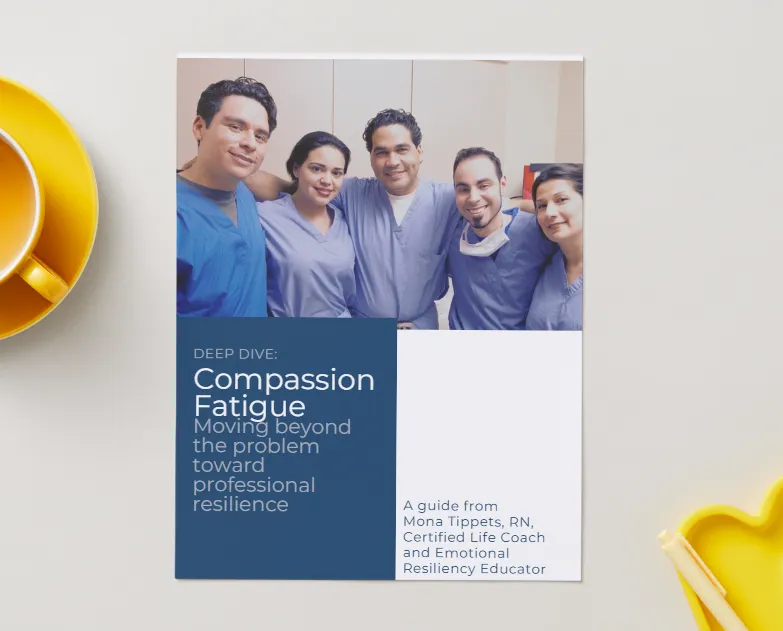
Get my Guide to Compassion Fatigue
Here I explain the risks of burnout and compassion fatigue, details of what I teach in the program and references to the studies done on the effectiveness of the program.
Real Outcomes for Healthcare Teams
Real savings — by protecting your most valuable asset: your people
Reduce staff stress and turnover
Empower your team to regulate their nervous system, stay calm under pressure, and thrive in demanding environments. Even one prevented resignation can save your organization tens of thousands in replacement costs.
Increased job satisfaction, retention and recruitment.
When employees feel regulated and supported, they show up with more energy, purpose, and pride in their work. They stay longer, and their enthusiasm attracts quality talent
Stronger teamwork
No more front office versus back office. Less reactivity means more collaboration and trust across teams. Employees support each other and have a shared purpose
Fewer missed shifts and sick days
Stress effects our physical health and our immune system. Regulated teams experience less stress-related illness, increasing staffing stability.
More compassionate interaction
Regulated providers connect better with colleagues, patients, and families. This continues beyond the profession and into personal lives as well.
Improved patient safety
More engaged staff deliver better care, improving safety and increasing your patient satisfaction which influences revenue.
Who This Is Perfect For
Anyone who takes care of people, including:
hospital units
out patient clinics
dental clinics
inpatient units
geriatric facilities
Veterinary clinics
PRICING
Options
Intro presentation
Tools for Emotional Resilience
45 minute presentation, plus Q&A
Perfect for staff meetings or leadership development
Learn the science behind stress
Walk away with practical skills your team can use immediately
Introductory price in 2026, $297
Full-Day Workshop
Forward Facing Professional Resilience
Deep dive to an evidence based intervention to resolve burnout, toxic stress and compassion fatigue.
Hands-on skill building and real workplace and personal application.
Build a sustainable, resilient culture
Starting at $2497 (limited time) Custom quote based on team size, meet with me for details.
TESTIMONIALS
What Participants Are Saying
"Loved everything so far
This program really helped me make sense of what was happening when the job started to wear me down. It gave me a way to reset in the moment, instead of just pushing through or pretending I was fine. I feel steadier now - more in control, more myself - and I've actually started to enjoy my work again.
-Pete, Chief Police Officer

"Every day is better"
The skills I learned here taught me how to manage my stress. What put me over the edge before is now doable with ease.
- Rachel, Mental Health RN
"Highly recommend this"
"Forward-Facing really helped me take my professional resilience to the next level. I no longer feel like the only solution to compassion fatigue is 'just take care of yourself.' I am truly enjoying my work again and have much more confidence that I can handle the challenges that come my way."
Amy, LPC and Regional Directorrector
HOW IT WORKS
Three Steps To a Healthier Team
Schedule a call with me
We'll talk about what your team is dealing with, what you've tried, and what you need.
Get a custom plan
I'll propose a format, timeline, and scope that fits your team and your budget.
Run the workshop
Your team gets practical tools, a shared language for stress, and permission to stop pretending they're fine
Here's the truth-
Your team doesn't need to be tougher. They need to be taught.
I know you want a team of employees and coworkers that shows up energized, treat patients with patience, and is dedicated to staying. To get there, your people need something no one gave them in school: a working understanding of their own stress response. Without it, they push harder until they break, and you lose them.
I believe burnout is human physiology patterns, not weakness, and I've seen what happens when a team finally understands that.
I'll give your staff the tools to work differently, not harder, so they can keep caring without burning out.
Let's talk about what your clinic needs.
Questions? I got you.
Frequently Asked Questions
Everything you're wondering before you book
What is burnout coaching?
Burnout coaching is one-on-one support that helps you understand why you're exhausted and what to do about it. It's not therapy and it's not a pep talk. It's practical, forward-looking work focused on your nervous system, your thought patterns, and how you respond to stress. You leave with tools you can use on your next shift, not just insight that fades by Monday.
How do I know if I'm burned out or just tired?
Tired gets better with rest. Burnout doesn't. If you've taken a vacation and come back just as depleted, if you've lost the compassion you used to feel for patients or students, if you're doubting whether you're any good at a job you used to be great at, that's burnout. It has three signatures: exhaustion, cynicism or detachment, and feeling less effective than you know you are. If you're nodding along, you're in the right place.
How is burnout coaching different from therapy?
Therapy often looks backward to heal past wounds and treat mental health conditions. Coaching looks forward: where are you now, where do you want to be, and what's in the way. Many of my clients do both, and they complement each other well. If at any point I think you'd be better served by a therapist or physician, I'll tell you. That's part of taking care of you.
Why do you focus on the nervous system?
Because burnout lives in your body, not just your calendar. Your nervous system decides whether you feel safe or threatened, and chronic stress trains it to stay on high alert. That's why "just rest more" doesn't work. You can't relax your way out of a system that thinks it's protecting you. Using neuroscience and Polyvagal Theory, we retrain that system so calm becomes available again. It's the difference between managing symptoms and changing the pattern.
What is Polyvagal Theory? (in plain English)
Your nervous system has three main gears: connected and calm, mobilized (fight or flight), and shut down (freeze). Stress shifts you out of the calm gear, and chronic stress can leave you stuck in the other two. Polyvagal Theory explains how that happens and, more importantly, how to shift back. Once you can recognize which gear you're in, you can do something about it. Isn't that so cool?
Do I have to leave my job to recover?
No. Most of my clients stay in the careers they love. The goal isn't to escape your work, it's to change your relationship with stress so the work stops costing you your health and your family. Some people do decide to make a change, and that's okay too. But it's a choice you make from a regulated place, not a desperate one.
How long does it take?
Most people notice a shift in the first few sessions, once they understand what their nervous system is doing. Lasting change, the kind that holds up during a 12-hour shift or a rough week at home, typically takes a few months of consistent work. That's why my core program is 12 sessions. It's long enough to rewire a pattern, not just learn about it.
I work night shifts and my schedule is chaos. Can this work for me?
First of all. a huge thank you! I've spent many years working nights. And, Yes. Sessions are virtual, I have flexible hours, and everything we do is designed to fit into a real life with an unpredictable schedule. I was a nurse. I know what "I'll try to squeeze it in" actually means.
What happens on the free Burnout Discovery Call?
We talk. You tell me what's going on and what you've already tried. I ask questions, listen, and share what I'm noticing. If it seems like a fit, I'll walk you through the options. If it doesn't, I'll tell you that too and point you somewhere better. No pressure, no script.
Do you work with people who aren't in healthcare?
Absolutely. Burnout doesn't check your job title. I work with teachers, therapists, veterinary professionals, leaders, and parents, anyone who's a high achiever in a helping role and running on empty.
Do you offer coaching for teams or organizations?
Yes. I bring workshops to hospitals, dental practices, veterinary clinics, and other teams.
Questions? I got you
Frequently Asked Questions
These are the top questions I get asked, you probably want the answer too.
Do you come to us, or is this virtual?
Both, though I'll be honest about my preference: in person works better. Nervous system work is experiential, and a room full of people practicing together does something a screen can't. That said, virtual is a real option and I do it well, especially for teams spread across locations. I travel for on-site workshops, and travel costs get worked into the quote.
We run multiple shifts. Can everyone actually attend?
Yes. I teach at different times of day, including nights, and I regularly split a workshop so day and night staff each get the full workshop. Your night crew is often the group that needs this most, and they're used to being the ones who miss out. Let's not do that to them.
How big can the group be?
Up to 50 people at a time. There's no minimum, so a six-person practice and a full unit both work. Pricing shifts with group size, which is one of the few things I can't put a flat number on until I know what we're working with.
What does it cost?
The 45-minute intro presentation starts at $297. The full-day Forward Facing Professional Resilience workshop starts at $2,497 for groups up to 15, and scales from there based on team size and travel. You'll get a firm number on our call, not a "contact us for pricing" runaround
How do payment and scheduling work?
I invoice. Fifty percent reserves your date, and the balance is due the day of the presentation. That deposit isn't refundable, but I'm happy to reschedule with at least one week's notice. Life in healthcare is unpredictable and I plan for that.
Can the full day be broken into shorter sessions?
t can, and sometimes that's the only way it fits a schedule. I'll tell you straight, though: it works better as a single day. The material builds, and the group momentum matters. If we do split it, I'll structure it so each piece still stands on its own.
What do we need to provide?
A room, something to project onto, and basic AV. I bring all the printed materials. If you're in the Boise, Idaho area and don't have a good space, I have some favorite spaces that work really well.
How will we know it worked?
If you want data, for the full-day workshop I include a pre-session survey so we have a baseline, and I recommend a follow-up survey at six months so you can see what actually held. I also recommend a group check-in at three months and again at six. Not because the tools don't stick, but because reinforcement is how anything becomes culture instead of a nice day off the floor. I also know when everyone takes this training together, they discuss it, they have the same vocabulary and you'll see progress in how everyone interacts with each other. The change is often palpable very quickly.
How is this different from the resilience training we already tried?
Most resilience training tells people to be more resilient. This teaches them why their body is doing what it's doing, and gives them something to do about it in the moment. It's built on neuroscience, Polyvagal Theory, and the Forward Facing® model, an evidence-based intervention with published research behind it. I'm a certified Forward Facing coach and consultant.
Also, it's taught by a nurse with over two decades in healthcare. Your staff will figure out in the first five minutes whether the person at the front of the room has done the work. I have.
Will our staff actually engage, or will they treat it as one more mandatory training?
This is the right question to ask. The reason people check out of wellness training is that it feels like being told the problem is them. This starts from the opposite place: burnout is physiology, not a personal failing, not something to blame on a "toxic workplace" or "something that just comes with the job." When that lands, defensiveness drops fast. People stop performing "I'm fine" and start asking real questions.
Do you offer CEUs?
Not yet. I'm in the process of trying to. I'd rather tell you that plainly than be vague about it.
What happens after the workshop?
I highly recommend follow-up trainings where I come back, reinforce concepts with everyone or just leadership at three months and again at six. Retraining a work culture isn't a quick fix and this is where more behavior change gets reinforced. I also offer one-on-one coaching for staff who want to go further to recover from burnout and plenty do once they've seen what this work can do.
Do you work with teams outside healthcare?
Yes. Schools, veterinary clinics, dental practices, clergy, first responders, foster families, law enforcement, and leadership teams. If your people spend their days taking care of other people, this applies.
TESTIMONIALS
What others are saying
— John D
Working with them has been a game-changer for me! I came into the coaching process feeling lost and unsure about my career path. Through insightful discussions and tailored strategies, I gained clarity on my goals and developed a concrete plan to achieve them. I now feel empowered and motivated to take action, and I couldn't be happier with the progress I've made!

— Sarah T
I never realized how much I was holding myself back until I started coaching with [Your Name]. Their support and encouragement helped me confront my fears and limiting beliefs head-on. The personalized approach made all the difference, allowing me to set realistic goals and achieve them step by step. I highly recommend me to anyone looking to make meaningful changes in their life!
STILL NOT SURE?
Frequently Asked Questions
Have questions about our services? You're in the right place!
Question 1: What can I expect from life coaching sessions?
In our life coaching sessions, you can expect personalized guidance focused on your specific goals and challenges. We will work together to identify your strengths, develop actionable strategies, and provide ongoing support to help you stay accountable and motivated throughout your journey.
Question 2: How long does the coaching process typically take?
The duration of the coaching process varies depending on individual goals and circumstances. Typically, clients engage in coaching for a minimum of three to six months to achieve meaningful progress, but we can tailor the timeframe to fit your unique needs and objectives.
Question 3: What if I’m not sure about my goals?
That's perfectly okay! Part of our coaching process involves exploring your values, passions, and aspirations to help you gain clarity on your goals. Together, we’ll uncover what truly matters to you, allowing you to set meaningful and achievable objectives.
Question 4: How do I know if coaching is right for me?
Coaching is ideal for anyone seeking personal growth, clarity, or support in navigating life’s challenges. If you’re feeling stuck, overwhelmed, or uncertain about your next steps, our coaching services can provide the insight and encouragement you need to move forward confidently.
Find the Perfect Coaching Package for You
Choose Your Plan
Basic Plan
$99/month
Personalized Goal Setting: Tailored support to define your goals.
Monthly Check-Ins: Regular sessions to stay on track.
Resource Library Access: Exclusive tools and materials available.

No contracts - cancel anytime
Standard Plan
$199/month
Bi-Weekly Sessions: More frequent coaching for deeper progress.
Customized Action Plans: Tailored strategies for your growth.
Priority Email Support: Fast responses to your inquiries.
No contracts - cancel anytime
Premium Plan
$299/month
Weekly Sessions: Intensive support for maximum potential.
Comprehensive evaluations for growth areas.
Exclusive Workshops: Access specialized training sessions.
No contracts - cancel anytime